
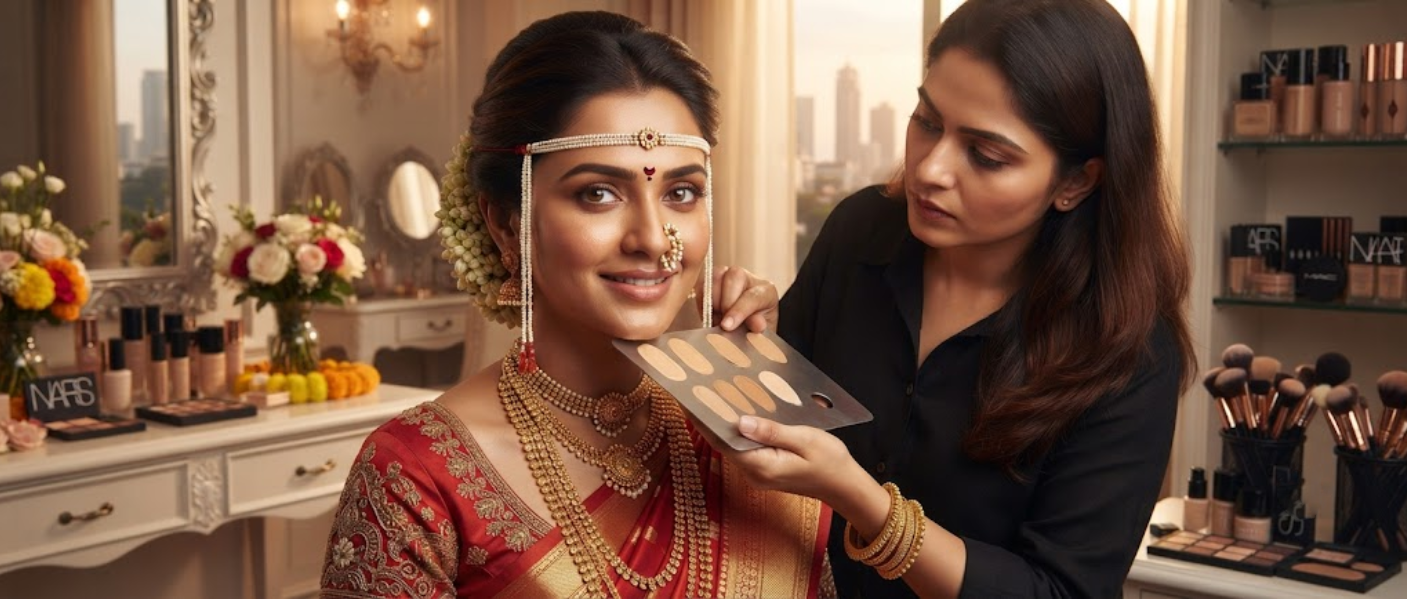
Choosing the right foundation shade is one of the most important steps in creating flawless bridal makeup. Your foundation forms the base of your entire look, and even beautifully blended eye makeup, perfectly shaped brows and stunning lipstick can look less polished if the foundation shade doesn’t match your skin correctly.
For brides, finding the right foundation shade is even more important because wedding makeup needs to look beautiful both in person and in photographs. Professional cameras, flash photography and different lighting conditions can make an incorrect foundation shade much more noticeable. A foundation that looks acceptable under indoor lighting may appear too light, too dark, too yellow or too pink when photographed.
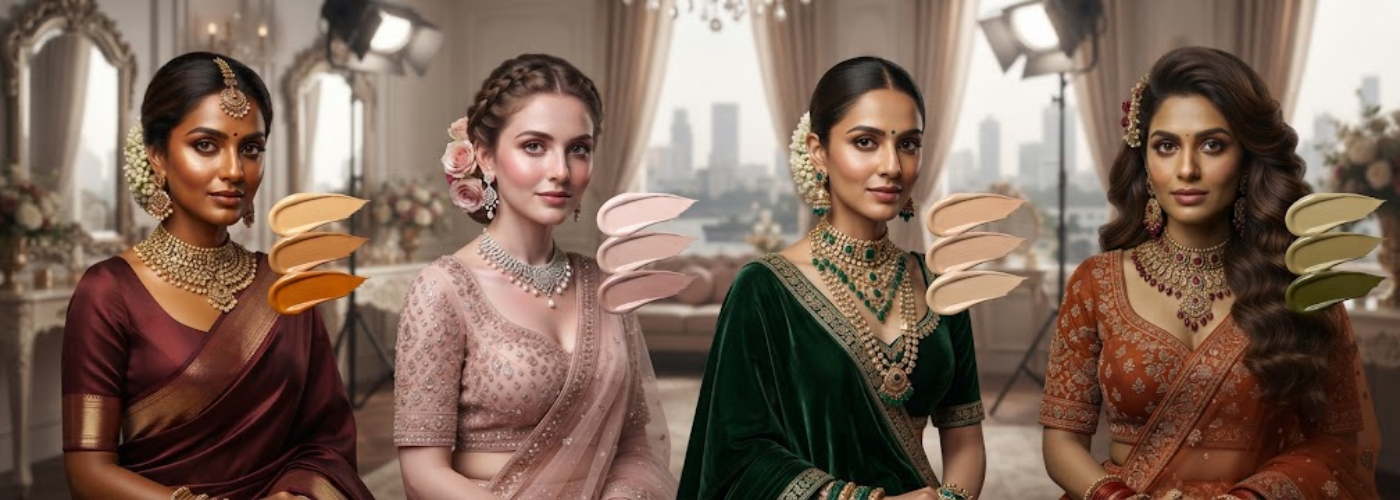
Indian skin tones are beautifully diverse, ranging from very fair to deep, with numerous undertones in between. Two brides with a similar skin depth can have completely different undertones. One may have warm golden undertones, another may have neutral undertones, while someone else may have cool or olive undertones. This is why choosing a foundation based only on whether your skin is “fair”, “medium” or “dark” isn’t enough.
Your wedding outfit, jewellery, lighting, photography style and skin type can also influence how the foundation appears.
For Mumbai brides, the local climate is another consideration. Heat and humidity can affect how foundation wears throughout a long wedding day. The right shade therefore needs to be paired with the right formula and application technique.
In this guide, we’ll explain how to identify your skin tone and undertone, where to test foundation, how to avoid common shade-matching mistakes, how to choose foundation for HD photography, and what brides should discuss with their makeup artist before the wedding.
The goal isn’t to make your skin look lighter or darker.
The goal is to make your complexion look even, natural, radiant and perfectly matched to your own skin.
1. Understand Skin Tone vs Skin Undertone
Before choosing a foundation, understand the difference between skin tone and undertone.
Skin tone refers to the overall depth of your skin.
It can generally range from:
- Very fair
- Fair
- Light
- Medium
- Tan
- Deep
Undertone refers to the subtle colour beneath the surface of your skin.
Common undertones include:
- Warm
- Cool
- Neutral
- Olive
Two people can have the same skin depth but different undertones.
For example, two medium-toned Indian brides may require completely different foundation shades because one has warm golden undertones while the other has neutral or olive undertones.
Understanding both is essential for accurate foundation matching.
2. How to Identify Your Skin Undertone
Your undertone can provide important clues when selecting foundation.
Vein Test
Look at the veins on the inside of your wrist.
If they appear mostly green, you may have warm undertones.
If they appear blue or purple, you may have cool undertones.
If it’s difficult to identify whether they’re blue or green, you may have neutral undertones.
Jewellery Test
Consider which jewellery tends to complement your skin.
If gold looks particularly flattering, you may lean warm.
If silver looks more flattering, you may lean cool.
If both look good, you may have neutral undertones.
However, these tests aren’t perfect.
Lighting can affect how your skin and veins appear, so professional shade matching is often more reliable.
3. Warm, Cool, Neutral and Olive Undertones
Understanding undertones can make foundation selection much easier.
Warm Undertones
Warm skin often has golden, yellow or peachy tones.
Cool Undertones
Cool skin may have pink, red or bluish undertones.
Neutral Undertones
Neutral skin combines warm and cool characteristics.
Olive Undertones
Olive skin can have a subtle green or muted golden appearance.
Indian skin can have a wide range of undertones, so don’t assume that all Indian skin is warm.
The foundation should match your individual complexion rather than your ethnicity.
4. Why Your Face May Not Be the Best Place to Test Foundation
Many people test foundation directly on their hand.
This can lead to incorrect shade selection.
The skin on your hand may be noticeably different from your face.
Your face may also have different pigmentation from your neck.
For bridal makeup, the goal is usually to create a seamless transition between your face, jawline and neck.
This is why your makeup artist may test foundation along the jawline rather than simply matching it to your hand.
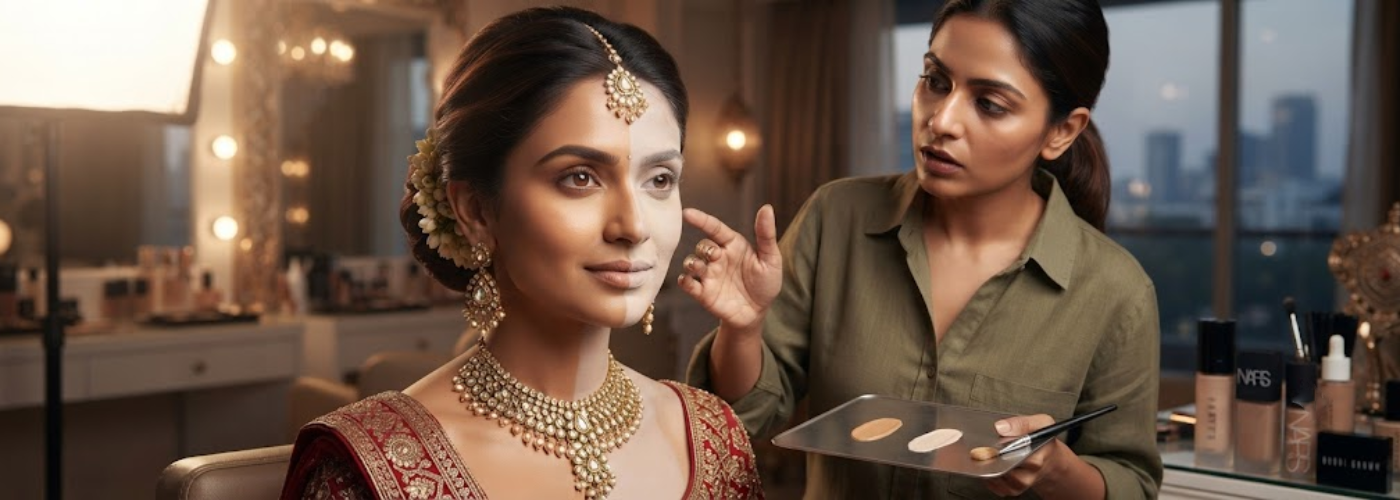
5. The Jawline Test: One of the Best Ways to Match Foundation
The jawline provides a useful transition point between your face and neck.
When testing foundation, apply a few closely related shades near the jawline.
Allow them to settle before making a decision.
The best shade should visually disappear into your skin rather than creating an obvious line.
Don’t choose a shade simply because it makes your face appear brighter.
Bridal foundation should look like your skin at its best—not like a completely different skin colour.
The right foundation shade should blend seamlessly from your face toward your neck without creating a visible colour boundary.
6. Check Foundation in Natural Light
Indoor lighting can be misleading.
A foundation that appears perfect under warm studio lights may look different in daylight.
Whenever possible, check the foundation in natural light.
Look at:
- Your jawline
- Face
- Neck
- Hairline
- Areas with pigmentation
Take a few photographs as well.
This is particularly useful because your wedding day will involve multiple lighting conditions.
7. Don't Choose Foundation Based on Fairness
One of the most common bridal makeup mistakes is choosing a foundation that is lighter than the natural skin tone.
A lighter foundation doesn’t automatically make the complexion look better.
It can instead create:
- A grey appearance
- A washed-out complexion
- A noticeable face-and-neck difference
- An unnatural appearance in photographs
Your wedding makeup should enhance your natural complexion.
The aim is an even, healthy and radiant appearance—not artificially lighter skin.
8. Consider Your Neck and Décolletage
Your face isn’t isolated from the rest of your appearance.
Depending on your bridal outfit, your neck and upper chest may be visible.
If your foundation matches your face but contrasts strongly with your neck, the overall makeup can appear unnatural.
A professional makeup artist can blend the complexion appropriately across the face, jawline and visible neck area.
The exact application will depend on the outfit and desired finish.
9. Foundation Shade for HD Bridal Photography
HD photography captures details extremely clearly.
A mismatched foundation can therefore become more noticeable.
Your makeup artist should consider:
- Foundation shade
- Undertone
- Coverage
- Finish
- Flash photography
- Lighting
The goal is a natural complexion that photographs beautifully without appearing overly pale or excessively orange.
This is particularly important when your wedding includes professional photography and videography.
10. Avoid the Wrong Undertone
You can choose the correct skin depth and still select the wrong foundation.
For example, a foundation may be the right level of medium but have a strongly pink undertone when your skin is golden or olive.
This can make the complexion appear:
- Too pink
- Too yellow
- Too orange
- Too grey
- Too ashy
Undertone matching is therefore just as important as shade depth.
11. How Skin Type Affects Foundation Choice
Shade is only one part of foundation selection.
Your skin type also matters.
Oily Skin
A suitable long-wearing formula may help manage shine.
Dry Skin
Hydrating preparation and a comfortable foundation can help prevent a patchy appearance.
Combination Skin
Different areas may require different preparation.
Sensitive Skin
Product compatibility and previous reactions should be considered.
This is why choosing foundation only by shade number isn’t enough.
12. Your Foundation Shade Can Change With the Season
Your skin colour can change slightly depending on sun exposure and season.
A shade that works during winter may appear different after spending more time outdoors during summer.
For brides, this means your makeup trial should ideally take place reasonably close to the wedding while still leaving enough time for adjustments.
If your skin tone changes significantly between the trial and wedding, tell your makeup artist.
13. What If You Are Between Two Foundation Shades?
Sometimes one foundation shade is slightly too light while the next is slightly too dark.
Instead of automatically choosing one, your makeup artist may mix compatible shades or adjust the complexion using other products.
Professional makeup artists often carry multiple shades because every bride’s complexion is different.
This is one reason hiring an experienced bridal makeup artist can make shade matching easier.
14. Foundation Shade Mistakes Brides Should Avoid
Avoid these common mistakes:
Matching Only to Your Hand
Your hand may not match your face or neck.
Choosing a Much Lighter Shade
Lighter doesn’t automatically mean brighter or more flattering.
Ignoring Undertone
The wrong undertone can make the complexion look unnatural.
Testing Only Under Artificial Lighting
Always consider natural light.
Buying Foundation Too Close to the Wedding
You need time to test the product.
Choosing Based Only on Online Swatches
Screen colours aren’t always accurate.
Using Someone Else's Shade
Even brides with similar skin tones may require different undertones.
15. Work With Your Bridal Makeup Artist
If you’re unsure about your foundation shade, don’t guess.
A professional bridal makeup artist can assess:
- Skin depth
- Undertone
- Skin type
- Wedding lighting
- Venue
They can also test the foundation before your wedding day.
Your makeup artist should aim to enhance your natural complexion rather than change your skin colour.
For brides in Mumbai, they can additionally consider the local climate and how the chosen foundation is likely to perform during a long ceremony.
The best foundation shade is the one that disappears into your complexion—not the one that makes your skin look several shades lighter.
Final Thoughts
Choosing the right foundation shade for bridal makeup isn’t simply about finding a colour that looks close to your face.
It is about understanding your skin depth, undertone, skin type, wedding environment and photography requirements.
Start by identifying your overall skin tone.
Then consider your undertone.
Are you warm, cool, neutral or olive?
Remember that Indian skin tones are incredibly diverse, and there is no single foundation shade that works for all Indian brides.
Avoid relying on your hand when testing foundation.
The jawline is generally more useful because it helps create a seamless transition between your face and neck.
Don’t choose a foundation just because it makes your face look lighter.
A foundation that is too light can create a grey, washed-out or unnatural appearance, particularly in photographs.
Your goal should be to look like yourself—with an even, radiant and polished complexion.
Natural lighting is also important.
Artificial studio lights can make a shade appear different from how it looks outdoors. Since your wedding photographs may include natural light, indoor lighting and flash, checking your makeup under multiple conditions is a smart step.
Photography deserves special attention.
HD cameras can capture small differences in colour, texture and blending. Your foundation therefore needs to be correctly matched not only for real life but also for the camera.
Skin type matters too.
Oily skin may require a long-wearing formula and strategic shine control. Dry skin may benefit from more hydrating preparation. Sensitive skin requires careful attention to product compatibility.
Your wedding season can also influence your shade and formula choice.
Sun exposure may slightly change your complexion, so communicate any changes to your makeup artist.
If you fall between two foundation shades, don’t panic.
A professional makeup artist may be able to mix compatible shades to create a closer match.
Most importantly, schedule a bridal makeup trial.
Don’t wait until the wedding morning to determine your foundation shade.
Test it along the jawline, allow it to settle, check it in natural light, take photographs and wear it for several hours.
This gives you and your makeup artist the opportunity to make adjustments before the big day.
For Mumbai brides, also consider heat, humidity and the duration of your wedding celebrations.
The right foundation isn’t only about colour. It also needs to perform comfortably throughout your event.
Ultimately, the perfect foundation shade should not be obvious.
It should blend seamlessly into your complexion and allow your other bridal features—your eyes, lips, jewellery, hairstyle and outfit—to shine.
The best bridal foundation doesn’t change your skin colour. It perfects the appearance of your natural complexion.